
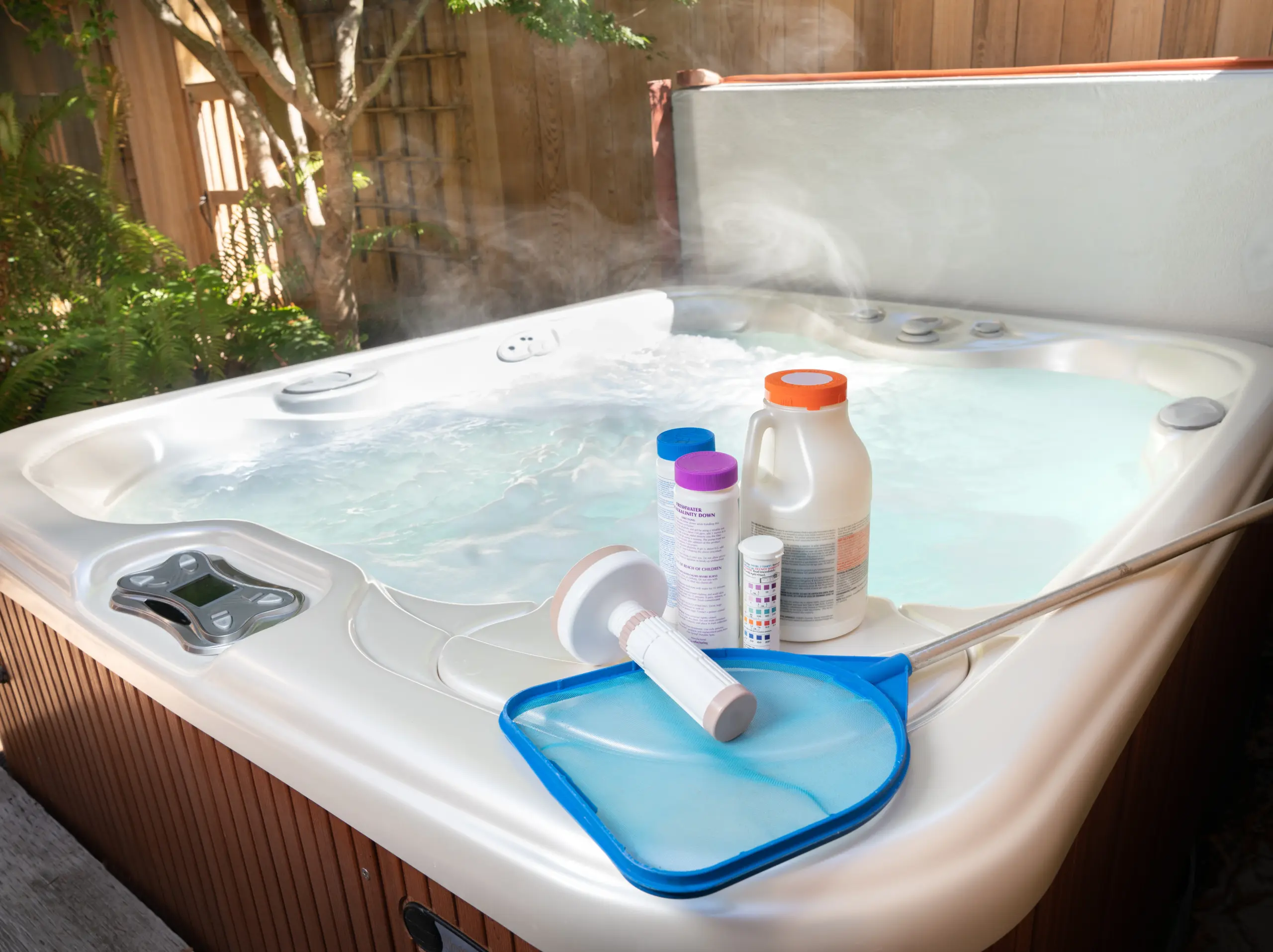
Maintaining clean, balanced water is an essential part of owning a hot tub. The right spa chemicals for hot tubs help control germs, maintain comfortable water conditions, reduce buildup, and protect spa equipment. However, not every hot tub needs every chemical available in a pool and spa store.
If you’re new to hot tub maintenance, start with a reliable water-testing kit, an appropriate sanitizer, and products for adjusting water balance. Additional treatments may be useful when you experience specific problems, such as cloudy water, foam, or mineral stains.
This guide explains which hot tub chemicals you really need, what each product does, how chlorine compares with bromine, and how to maintain your water safely.
What Chemicals Do You Need for a Hot Tub?
Most hot tubs require a sanitizer, pH adjustment products, and a way to monitor and balance the water. Other chemicals depend on the source water, spa system, and maintenance requirements.
Here are the main products to understand before buying a hot tub chemical kit.
| Chemical or product | Main purpose | Essential or optional? |
|---|---|---|
| Chlorine or bromine sanitizer | Controls harmful microorganisms | Essential for conventional systems |
| Water test strips or a suitable test kit | Measures sanitizer and pH levels | Essential |
| pH increaser and decreaser | Adjusts water acidity or alkalinity on the pH scale | As needed |
| Total alkalinity increaser | Helps stabilize pH | As needed |
| Hot tub shock treatment | Oxidizes accumulated contaminants or supports a specified sanitation program | According to the system |
| Calcium hardness increaser | Raises calcium hardness when required | Depends on source water and spa specifications |
| Filter cleaner | Removes oils and debris from filter cartridges | Periodic maintenance |
| Stain and scale control | Helps manage certain mineral deposits and metal staining | As needed |
| Water clarifier | Helps some filters capture fine suspended particles | Optional |
| Defoamer | Temporarily reduces surface foam | Optional |
| Plumbing line cleaner | Helps remove buildup from internal plumbing before draining | Periodic maintenance, as directed |
The key is to test the water before adding a pH adjustment product. Make small, label-directed corrections and retest before making additional changes. Professional hot tub water testing and balancing can also help identify and correct persistent water chemistry problems.
1. Sanitizer: Chlorine or Bromine
Sanitizer is one of the most important parts of hot tub water care. Warm water and frequent use create conditions in which microorganisms can spread if disinfection is inadequate.
Most conventional hot tubs use either chlorine or bromine. Choose a system compatible with your spa and follow its manufacturer’s instructions.
Chlorine for Hot Tubs
Chlorine is a widely used sanitizer that helps control microorganisms in spa water. It is available in formulations specifically designed for hot tubs, including certain granular products.
Chlorine can be a practical choice for owners who want a familiar, widely available sanitation method. Its effectiveness depends on the concentration, pH, water conditions, and correct product use.
Important: Do not assume every pool chlorine product is suitable for a hot tub. Check the label and your spa manual. The CDC advises against using cyanuric acid or chlorine products containing cyanuric acid in hot tubs.
Bromine for Hot Tubs
Bromine is another sanitizer commonly used in hot tubs. It is available in compatible spa-care formulations and is often selected for warm-water applications.
Bromine has different chemical behavior from chlorine, so testing and dosing instructions are not interchangeable. Use a test kit that measures the sanitizer in your system and maintain the level specified by the manufacturer.
Chlorine vs. Bromine: Which Is Better?
Neither option is universally best. The right choice depends on your spa’s equipment, maintenance preferences, and approved water-care system.
| Consideration | Chlorine | Bromine |
|---|---|---|
| Primary role | Sanitizes water | Sanitizes water |
| Availability | Widely available in spa formulations | Widely available in spa formulations |
| Monitoring | Requires regular testing | Requires regular testing |
| Product compatibility | Must match the hot tub system | Must match the hot tub system |
| Best choice | Depends on your equipment and routine | Depends on your equipment and routine |
Choose one compatible primary sanitation system rather than mixing different sanitizers without explicit manufacturer guidance. Never mix chemical products together.
2. pH Increaser and pH Decreaser
pH measures how acidic or basic the water is. Keeping it within the recommended range helps maintain sanitizer performance, user comfort, and equipment condition.
A pH increaser raises the pH when it is too low. A pH decreaser lowers it when it is too high.
The CDC recommends a pH range of 7.0–7.8 for hot tubs. Your spa manufacturer may specify a narrower operating range, so consult its water-care guide as well.
If the pH is too low, water may contribute to corrosion or equipment damage. If it is too high, chlorine becomes less effective at killing germs, and mineral deposits may become more likely.
Maintenance tip: Test the water before adding a pH adjustment product. Make small, label-directed corrections and retest before making additional changes.
3. Total Alkalinity Increaser
Total alkalinity helps resist sudden changes in pH. When alkalinity is poorly balanced, the pH can become harder to control.
An alkalinity increaser is used when testing shows that total alkalinity is below the range recommended for your spa. Some products can affect both alkalinity and pH, so retest both after treatment.
A range of 80–120 parts per million (ppm) is commonly used in many spa-care programs, but it should not be treated as universal. Follow the specifications for your particular water-care system.
Keep in mind that pH and total alkalinity are related but measure different things. Adjusting one does not automatically bring the other into its correct range.
4. Hot Tub Shock Treatment
Shock products are used in certain maintenance programs to oxidize organic contaminants and address the buildup of unwanted compounds. Some treatments also support a particular disinfection routine.
Hot tub shock products are not all the same. They may be chlorine-based or non-chlorine oxidizers, and their purposes and instructions differ.
Before choosing one, check whether it is compatible with your sanitizer and spa system. Follow the specified dosage, circulation time, and waiting period before using the hot tub.
Shock treatment does not replace the need to maintain the required sanitizer level. It is also not a substitute for correcting a persistent water-quality problem.
5. Calcium Hardness Increaser
Calcium hardness refers to the amount of dissolved calcium in the water. Levels that are too low or too high can affect water balance and equipment condition.
A calcium hardness increaser raises the calcium level when needed. It is not automatically necessary for every hot tub because the starting hardness depends on the source water and the spa’s requirements.
Excessive calcium hardness can contribute to scale formation, especially when pH and other water conditions are poorly balanced. Test before adding a hardness-adjusting product.
If your water contains unusually high mineral levels, ask your spa dealer or water-care specialist whether a different filling-water source or another treatment approach is appropriate.
6. Optional Spa Water-Care Products
Some products can help with specific maintenance problems, but they should not replace proper sanitation, testing, or filtration.Periodic plumbing care, along with professional hot tub draining and cleaning, helps remove accumulated residue and maintain your spa’s water quality.
Water Clarifiers
Clarifiers help certain filtration systems capture small suspended particles that contribute to cloudy water. They are not a substitute for correcting sanitizer levels, cleaning a dirty filter, or addressing contamination.
Stain and Scale Control
These products can help manage particular metals or mineral deposits in the water. Choose a treatment based on the actual problem and confirm that it is compatible with your spa.
Defoamer
Foam may result from soap, detergent, body oils, lotions, and other contaminants. A compatible defoamer may reduce visible foam temporarily, but it does not remove the underlying cause.
If foam keeps returning, check bathing-product residues, water balance, and filter condition instead of repeatedly adding defoamer.
Filter Cleaner
Filter cleaner is designed to remove accumulated oils and debris from compatible filter cartridges. Follow the filter manufacturer’s cleaning instructions, rinse thoroughly where required, and replace the cartridge when it reaches the end of its service life.
Plumbing Line Cleaner
Plumbing line cleaners are generally used before draining and refilling a spa, according to the product instructions. They can help remove buildup from internal plumbing that ordinary surface cleaning does not reach.
Use only a product approved for your system and complete the specified cleaning, draining, and rinsing process.
What Chemicals Do You Put in a Hot Tub First?
The correct sequence depends on your starting water conditions and the products you use. A practical approach is to test first, correct water balance, establish sanitation, and then perform any additional treatment required by your maintenance program.
Step 1: Test the Water
Use an appropriate test kit to measure sanitizer levels and pH. Check total alkalinity and calcium hardness when required by your spa’s water-care schedule.
Step 2: Adjust Total Alkalinity if Necessary
If the alkalinity reading is outside your manufacturer’s recommended range, use a suitable adjustment product according to its label. Allow circulation for the specified period and retest.
Step 3: Correct pH
Once the water balance has been checked, adjust pH as needed. Because pH and alkalinity interact, further testing may be necessary before the water is balanced.
Step 4: Establish the Correct Sanitizer Level
Add the appropriate chlorine or bromine product according to your system’s instructions. Never combine different sanitizer products or assume that the same dose works for every spa.
Step 5: Use Shock Only When Required
If your maintenance program calls for shock treatment, use the compatible product and follow its label. Some systems specify particular treatment sequences, so do not assume that shock must always be the final chemical added.
Step 6: Retest Before Use
Confirm that the water meets the required sanitizer and pH ranges, and observe the product’s circulation and waiting-time instructions. Do not enter the hot tub if the water is inadequately sanitized or the chemical levels are outside the permitted range.
Chemical safety reminder: Never mix spa chemicals with each other. In particular, mixing chlorine products with acids can release toxic gas. Keep chemicals in their original labeled containers, handle them according to their safety instructions, and store them separately in a cool, dry location.
What Are the Correct Chemical Levels for a Hot Tub?
Chemical targets depend on the sanitizer, spa model, and product instructions. The CDC provides the following public-health guidance for hot tubs:
| Water measurement | CDC guidance |
|---|---|
| Chlorine | At least 3 ppm |
| Bromine | 4–8 ppm |
| pH | 7.0–7.8 |
These are public-health reference values, not a replacement for the operating limits specified by your spa and chemical manufacturers. Check your water-care instructions for the applicable target range and upper limits.
Test sanitizer and pH regularly, including before use and more frequently during heavy use. Clear-looking water alone does not prove that it is properly sanitized.
How Often Should You Add Spa Chemicals?
There is no single schedule that works for every hot tub. The right frequency depends on how often the spa is used, the number of bathers, the water-care system, and the test results.
Daily or Before Use
- Check sanitizer and pH according to your spa’s instructions.
- Inspect the water for unusual cloudiness, discoloration, or foam.
- Confirm that the circulation and filtration system is operating correctly.
Weekly or According to Your Water-Care Program
- Review sanitizer and pH readings more closely.
- Check total alkalinity and other balance measurements as recommended.
- Clean the filter when required.
- Apply compatible shock treatment if your program calls for it.
Periodically
- Deep-clean the filter as directed.
- Inspect for scale or other deposits.
- Clean the plumbing when appropriate.
- Drain, clean, and refill the hot tub according to the manufacturer and water conditions.
Testing is more useful than blindly following a fixed chemical-addition schedule. If readings repeatedly fall outside the correct range, investigate the cause instead of adding more products without checking the water.
Common Hot Tub Water Problems and How to Address Them
Why Is My Hot Tub Water Cloudy?
Cloudy water can result from inadequate sanitation, an overloaded or dirty filter, suspended particles, or unbalanced water.
Start by testing sanitizer and pH, then inspect the filter and follow your spa’s troubleshooting instructions. A clarifier may help with some particle-related problems, but it will not resolve every cause of cloudy water.
Why Does My Hot Tub Have Foam?
Foam often comes from detergent residues, lotions, body oils, and other organic contaminants. A defoamer may provide temporary relief, but persistent foam calls for checking the filter, water balance, and possible need for a water change.
Why Does My Hot Tub Smell Strongly of Chemicals?
A strong chemical odor should not automatically be interpreted as a sign that more sanitizer is needed. It can indicate a water-quality issue or accumulated contaminants.
Test the water, review your maintenance routine, and follow the manufacturer’s corrective guidance. Avoid using the spa until its water quality has been confirmed.
Why Does Scale Form on Hot Tub Surfaces?
Scale can develop when mineral content and water balance favor deposits. Test calcium hardness and pH, and use a compatible scale-control product only if appropriate.
If deposits keep returning, investigate the source water and the overall balance rather than relying solely on a scale treatment.
What Are the Healthiest Chemicals to Use in a Hot Tub?
No sanitizer should be considered harmless simply because it is marketed as natural, mineral-based, or gentle. The important factors are whether the product is approved for the spa, used correctly, and able to maintain effective sanitation.
Chlorine and bromine are established hot tub sanitation options. Mineral systems and other supplemental technologies may support particular water-care programs, but they do not necessarily eliminate the need for a sanitizer.
Avoid choosing products solely on claims about being chemical-free. Follow the manufacturer’s instructions, test the water consistently, and keep all chemical products away from children and pets.
How to Choose the Best Spa Chemicals for Hot Tubs
Before purchasing a spa chemical kit, consider these points:
- Spa compatibility: Confirm that every product is approved for your particular hot tub and water-care system.
- Sanitizer choice: Select a compatible chlorine or bromine system and use the appropriate test kit.
- Water source: Check whether your filling water requires adjustments for alkalinity, pH, or calcium hardness.
- Maintenance requirements: Choose products that fit the manufacturer’s routine rather than buying every available treatment.
- Clear instructions: Look for clearly labeled dosage, handling, storage, and waiting-time directions.
- Testing supplies: Make sure you have a reliable way to monitor the parameters that matter for your system.
A basic, compatible set of water-care products is generally a better starting point than an assortment of unnecessary treatments.
Keep Your Hot Tub Water Clean With the Right Routine
Choosing spa chemicals for hot tubs becomes much easier when you understand the purpose of each product. Sanitizer controls microorganisms, pH and alkalinity adjustments help balance the water, and other treatments address specific maintenance needs.
Test the water before making adjustments, use only compatible products, and follow the instructions for your spa. If the water remains cloudy, develops a strong odor, or repeatedly becomes unbalanced, investigate the underlying problem instead of relying on additional chemicals alone.
Consistent testing, proper filtration, and careful chemical handling are the foundations of dependable hot tub water care.
Frequently Asked Questions
What chemicals do you really need for a hot tub?
Most conventional hot tubs need a compatible sanitizer, a suitable water-testing kit, and products for adjusting pH and total alkalinity when necessary. Calcium hardness increaser and other treatments depend on the source water, spa requirements, and specific maintenance problems.
What chemicals do you put in a hot tub first?
Test the water before adding chemicals. Correct alkalinity and pH as needed, establish the appropriate sanitizer level, and use shock treatment only when required by your water-care program. Always follow product-specific instructions.
Which is better for a spa, chlorine or bromine?
Both can sanitize hot tub water when used correctly. The best option depends on your spa’s approved water-care system, product compatibility, and maintenance preferences. Neither should be mixed with the other unless the manufacturer explicitly directs a compatible procedure.
What are the healthiest chemicals to use in a hot tub?
Use a compatible, properly labeled sanitizer and maintain the required water balance. Chlorine and bromine are common options, while supplemental systems may support water care. No product eliminates the need for proper testing and sanitation.
How often should hot tub water be tested?
Follow your spa manufacturer’s testing schedule, checking sanitizer and pH regularly and more often when usage increases. The CDC recommends frequent testing for hot tubs and emphasizes maintaining appropriate disinfectant and pH levels.
Why is my hot tub water cloudy even after adding chemicals?
Possible causes include inadequate sanitation, poor filtration, suspended particles, or imbalanced water. Retest sanitizer and pH, inspect the filter, and follow the spa manufacturer’s troubleshooting guidance before adding further treatment.
Do you need hot tub shock every week?
Not necessarily. Shock frequency depends on the sanitizer system, product instructions, water usage, and water condition. Follow your maintenance program rather than assuming every hot tub needs the same weekly treatment.
Can you use regular pool chemicals in a hot tub?
Only when the specific product is labeled as suitable for your spa and compatible with its water-care system. Some pool products are unsuitable for hot tubs, so check the label and manufacturer guidance before use.
Why does my hot tub smell strongly of chlorine?
A strong odor can indicate a water-quality problem or accumulated contaminants. Test the water, review your maintenance routine, and follow the manufacturer’s corrective instructions instead of automatically adding more chlorine.
What should you do if hot tub chemicals are not balancing the water?
Retest the water, verify that the test kit is suitable and in date, check the dosage instructions, and review the source water and filter condition. If readings remain unstable, consult a qualified spa water-care professional or your hot tub manufacturer.